The problem: the knowledge existed, the access did not
At BMW, knowledge was spread across more than 1,000 internal documents. Finding the right answer often took too long, and people depended too much on already knowing roughly where the information might sit.
That is a fragile way to run a knowledge-heavy team. The quality of an answer ends up correlating with how long someone has been around rather than with what the organization actually knows. And the failure mode is quiet: nobody is blocked outright, people just settle for the document they can find instead of the document they need.
The goal
Build an assistant that lets the team ask questions in plain language and get answers grounded in BMW's own content. No new place to file things, no new process to learn, and no answer the underlying material does not actually support.
How I built it
I self-initiated the project and built it on BMW's internal AI platform. The work split into four parts, and only one of them was about the model.
Data model first. Before any retrieval logic, I designed how the documents should be represented: what counts as a unit of knowledge, what metadata each unit carries, and how the pieces relate to each other. Retrieval quality is mostly a data-preparation problem, so treating this as a modelling step rather than an indexing step is what pays off later.
Cleaning and structuring. I cleaned and structured the source documents so the corpus was consistent enough to chunk sensibly, instead of pointing an embedding model at a pile of raw files and hoping.
Chunking and retrieval. I built the chunking and retrieval logic so that a question returns passages carrying enough surrounding context to stand on their own.
A fallback for weak evidence. I added a fallback so the system avoids guessing when the source material is thin. This is the part most internal assistants skip, and it is the part that decides whether people trust the tool. An assistant that confidently invents an answer once does not get used a second time. One that says the material does not cover this keeps its credibility.
The use case that made it click: playbook retrieval
A core use case was playbook retrieval. A consultant could describe a dealer's current challenge in their own words and instantly surface how dealers in other markets had solved a similar problem.
That reframes the assistant from a search box into institutional memory. The useful unit of retrieval is not a document, it is a precedent: someone, somewhere in the network, has already met this situation and written down what worked.
What actually happened
The assistant was adopted by 12 consultants across international markets, saving each of them around 2 to 3 hours per week. Localized versions were later rolled out to South Africa and Australia.
I also ran a 3-hour enablement workshop for 15 attendees to drive adoption. That part was deliberate. A tool nobody knows how to ask is indistinguishable from a tool that does not exist, so enablement was scoped as part of shipping rather than as a follow-up.
Where the skills came from, and what carried forward
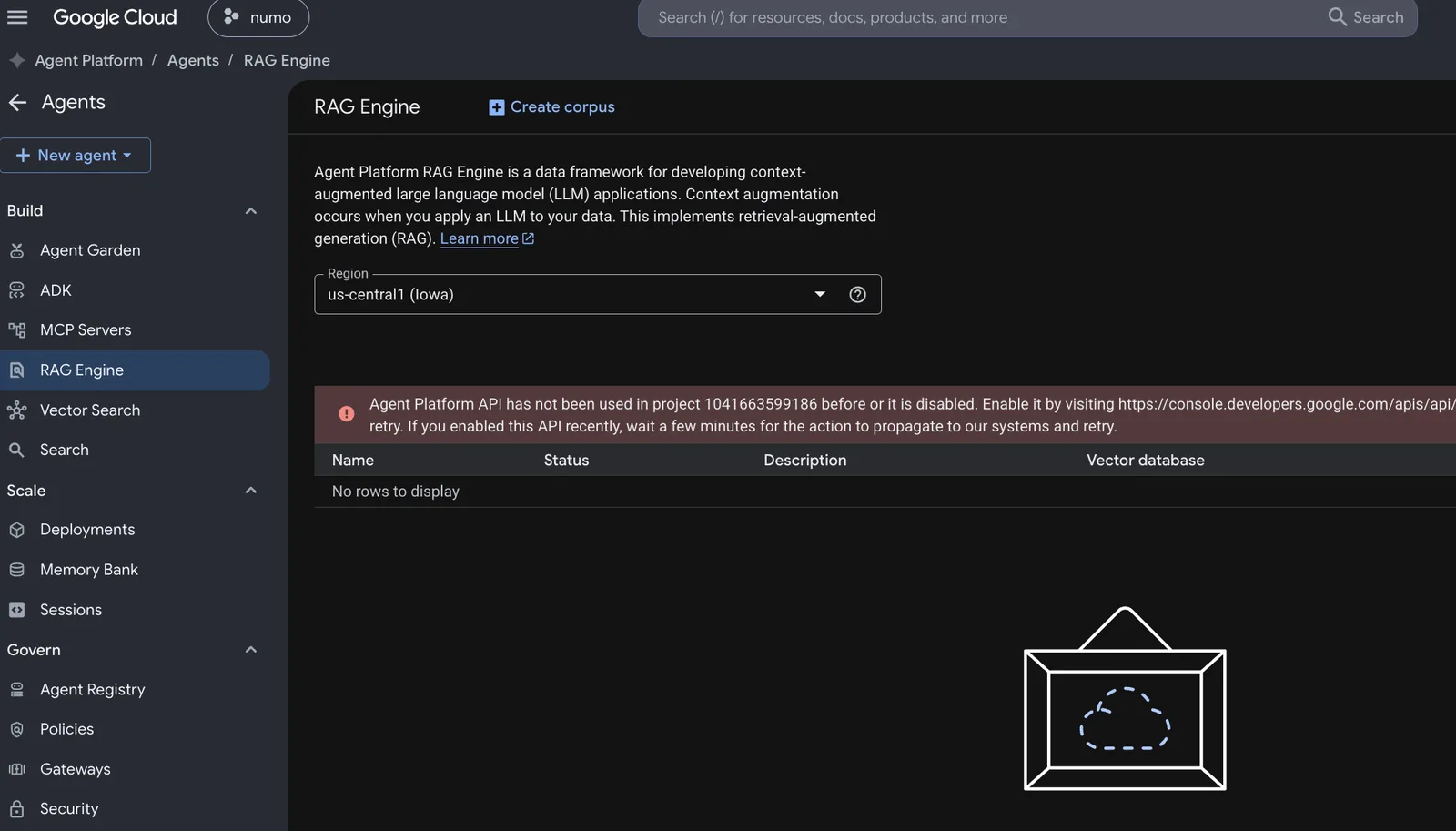
I learned RAG hands-on on Google Cloud and Vertex AI before implementing it at BMW, which is also where the representative visual on this page comes from.
Three lessons carried into the expert knowledge co-pilot I later built at Siemens Energy: put the effort into the corpus before the model, make refusal a first-class behaviour rather than an edge case, and treat enablement as part of the build.