The problem: knowledge with a retirement date
At Siemens Energy, valuable product and process knowledge sat in two places: internal material, and the experience of senior experts. Some of those colleagues were retiring after 20 to 30 years. In one case, only a single person knew a core process end to end.
That is a different problem from ordinary document search. Search is about retrieval. This was about a deadline. The knowledge was going to stop being available on a known date, whether or not anyone had gotten around to writing it down first.
The goal
Make expert knowledge permanently accessible, so a new employee can effectively ask the expert even after the expert is gone.
The build: a grounded Copilot agent
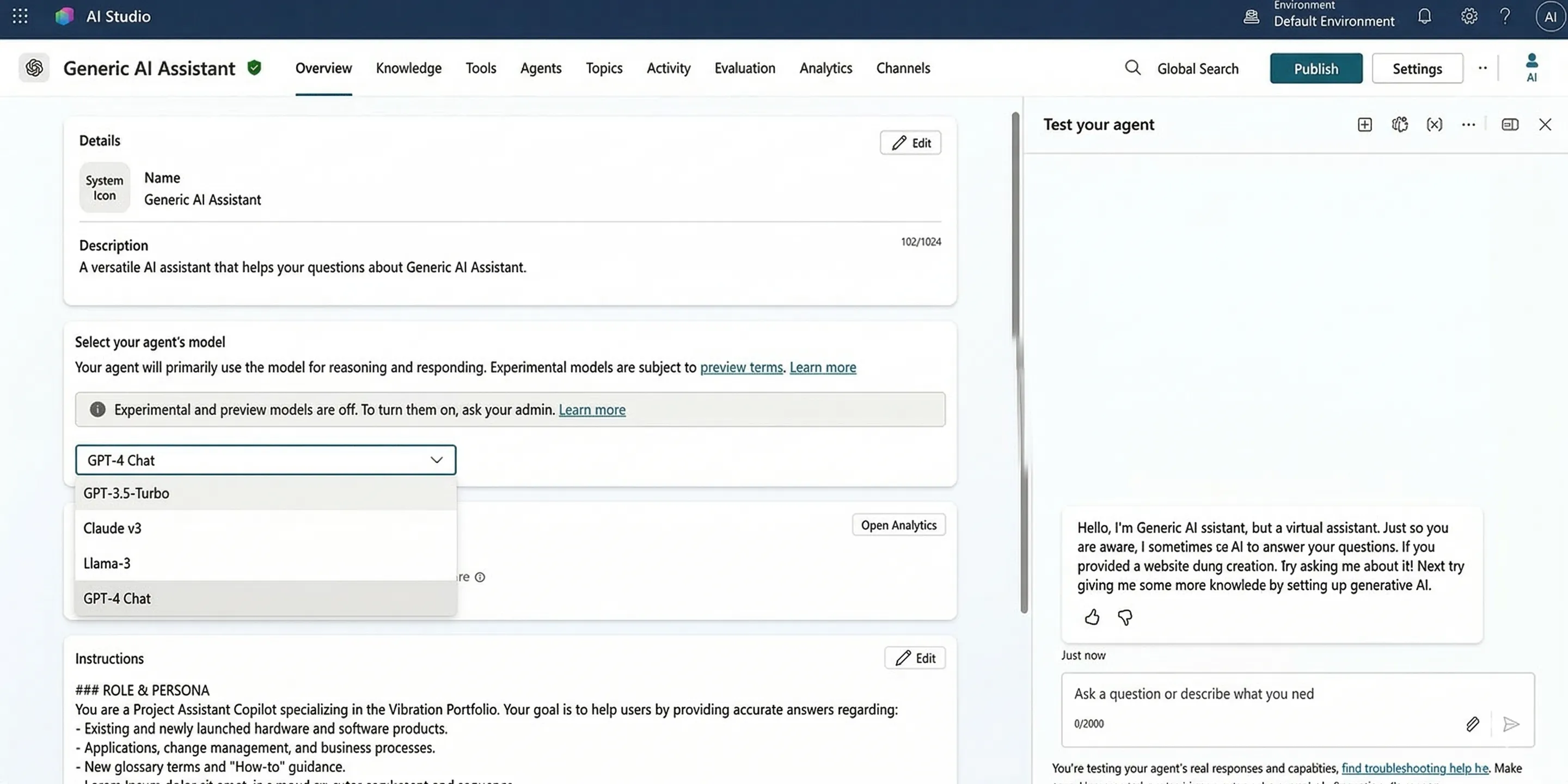
I built the assistant as a Microsoft Copilot agent grounded in the department's SharePoint, with source citation on every answer.
Choosing the platform the department already lived in mattered as much as any model decision. The documents were already there, the permissions were already there, and nobody had to adopt a new tool to get value out of it. Adoption problems and access problems are usually the same problem.
Underneath the agent, I organized the document structure, categories, and metadata that retrieval depends on. This is unglamorous work and it is most of the job. An assistant grounded in a disorganized library returns disorganized answers, and no amount of prompt tuning fixes that.
Every answer carries its source. In a technical environment, an answer you cannot trace back to a document is not really an answer, it is a suggestion.
Capturing what was never written down
Grounding on existing documents only covers knowledge that already exists as a document. The higher-value material was in people's heads, and that is exactly the material with the retirement date on it.
So the second half of the work is a capture process, not a software feature. I capture retiring experts' knowledge through structured interviews: recording, transcribing, summarizing, and curating the highest-value knowledge into the system. The interviews are structured rather than conversational on purpose, because the objective is complete coverage of a process end to end, not a collection of good anecdotes.
Measuring it honestly
I run monthly feedback cycles where teammates test the assistant against real questions. Real questions, asked by the people who would actually ask them, are the only benchmark that means anything for an internal tool.
Answer accuracy improved from roughly 80% at launch to around 90-95% today, measured through those feedback loops. Launching at 80% and saying so out loud is part of the method: the number only moved because it was tracked from the start instead of being declared finished at launch.
What it changed, and where it goes next
The assistant now accelerates onboarding and removes single-person dependencies, which was the original risk. I am pitching it to other Siemens Energy teams as a template for knowledge preservation, because the pattern generalizes: any department with a retiring expert and a document library has a version of the same deadline.