The problem: opinion at a volume nobody reads
Real customer opinion is buried in thousands of scattered reviews: Gartner Peer Insights, G2, Trustpilot, Reddit, YouTube comments. Reading them manually does not scale, so most teams simply do not.
What usually happens instead is that a team reads the loudest twenty reviews, forms a view, and defends that view for a year. The information was public the whole time. Nobody had the hours.
The internal version at Siemens Energy
At Siemens Energy I set up AI agents that take a product page, review thread, or comment chain, read every entry, and categorize the content: pain points, feature requests, objections, buying triggers, and positive and negative themes in the customers' own language.
Keeping the customers' own language is a deliberate constraint. The moment findings get paraphrased into internal vocabulary, they stop being evidence and start being opinion.
The output feeds a competitor sentiment heat map used in positioning and roadmap discussions, and it now keeps my competitive benchmarking refreshed continuously rather than as a one-off study.
Why I rebuilt it in the open
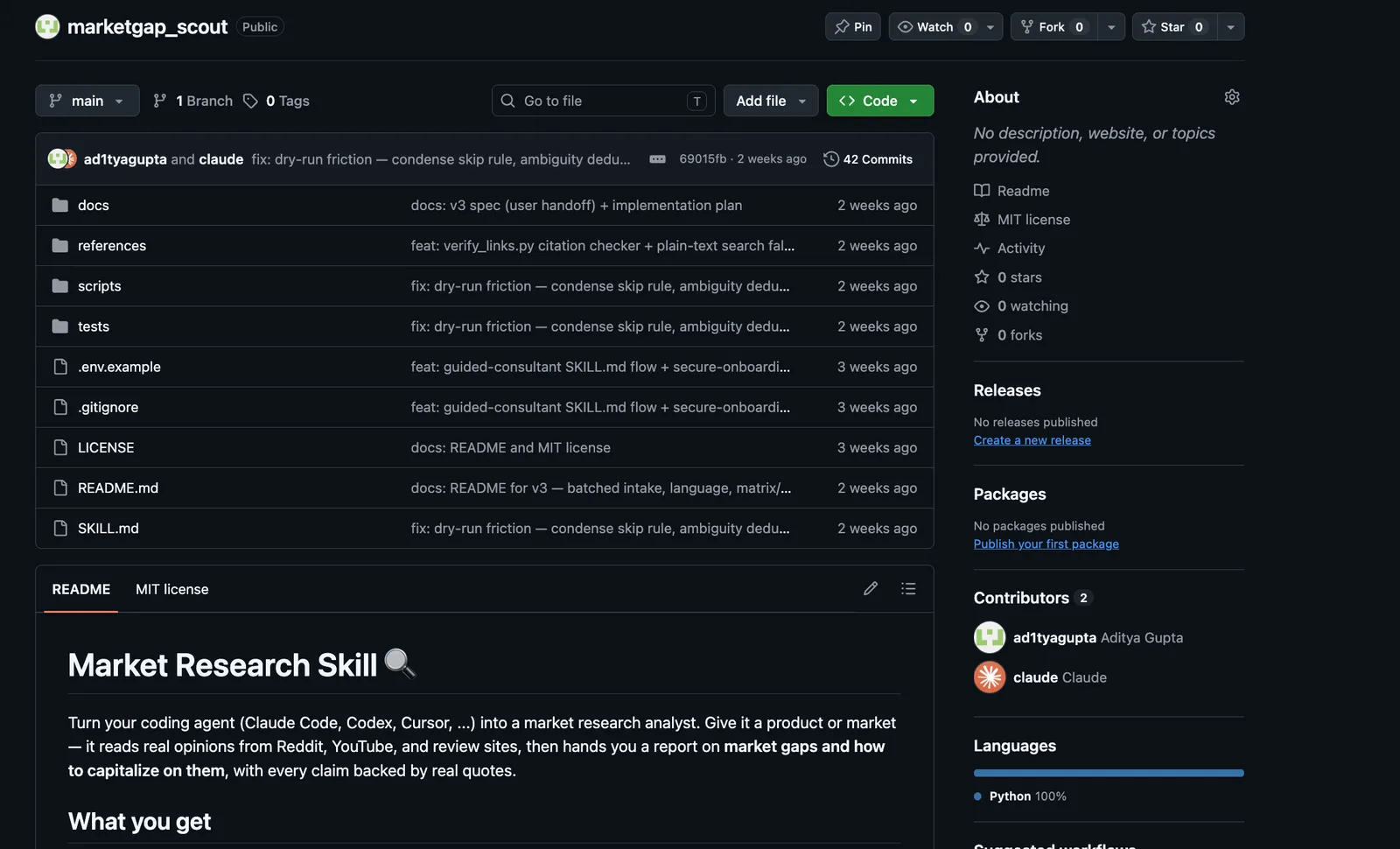
The internal version cannot be shared. The method can. So I rebuilt the same approach as a public, open-source tool: MarketGap Scout.
It turns any coding agent into a market research analyst. Give it a product or a market, and it reads real opinions from Reddit, YouTube, and review sites, then hands back a report on market gaps and how to capitalize on them.
The evidence rule is the product
Every claim in the output is backed by a real quote and a checked source link.
That constraint is the whole design. A market-research summary that cannot be traced back to a specific person saying a specific thing is indistinguishable from a plausible guess, and a plausible guess is exactly what a language model produces when you do not force it to cite. Making the source link checkable rather than merely present is the difference between a research tool and a confident-sounding one.
Proof that the method produces usable answers: Nextbike
The same method later produced a winning ad angle for a real paid campaign. Working on Nextbike's summer campaign for León, Spain, review mining surfaced that local buses stop around 10 pm while summer street life continues much later. That became one of our best-performing ad messages.
The wider campaign ran on Meta across Facebook and Instagram on a total spend of €1,500, and market penetration grew by more than 30% over May and June. The point for this page is narrower: the ad angle did not come from a brainstorm. It came from reading what people had already written down.